
Short answer: in St. Augustine a pool has two jobs a pool inland does not. It has to look like it belongs next to coquina, tabby and old stucco, and it has to survive salt air and sand. The good news is that the materials that do the first job usually do the second.
Start with the house
St. Augustine's look comes from shell stone and lime. Coquina, the shell rock that built the Castillo de San Marcos, and tabby, its lime-and-shell cousin, give the old city its warm, textured, sun-faded palette. The Flagler-era hotels and the Mediterranean Revival homes that followed added red tile roofs, arches and stucco. A pool that reads as part of that place borrows the palette and the textures instead of fighting them with bright blue and polished white.
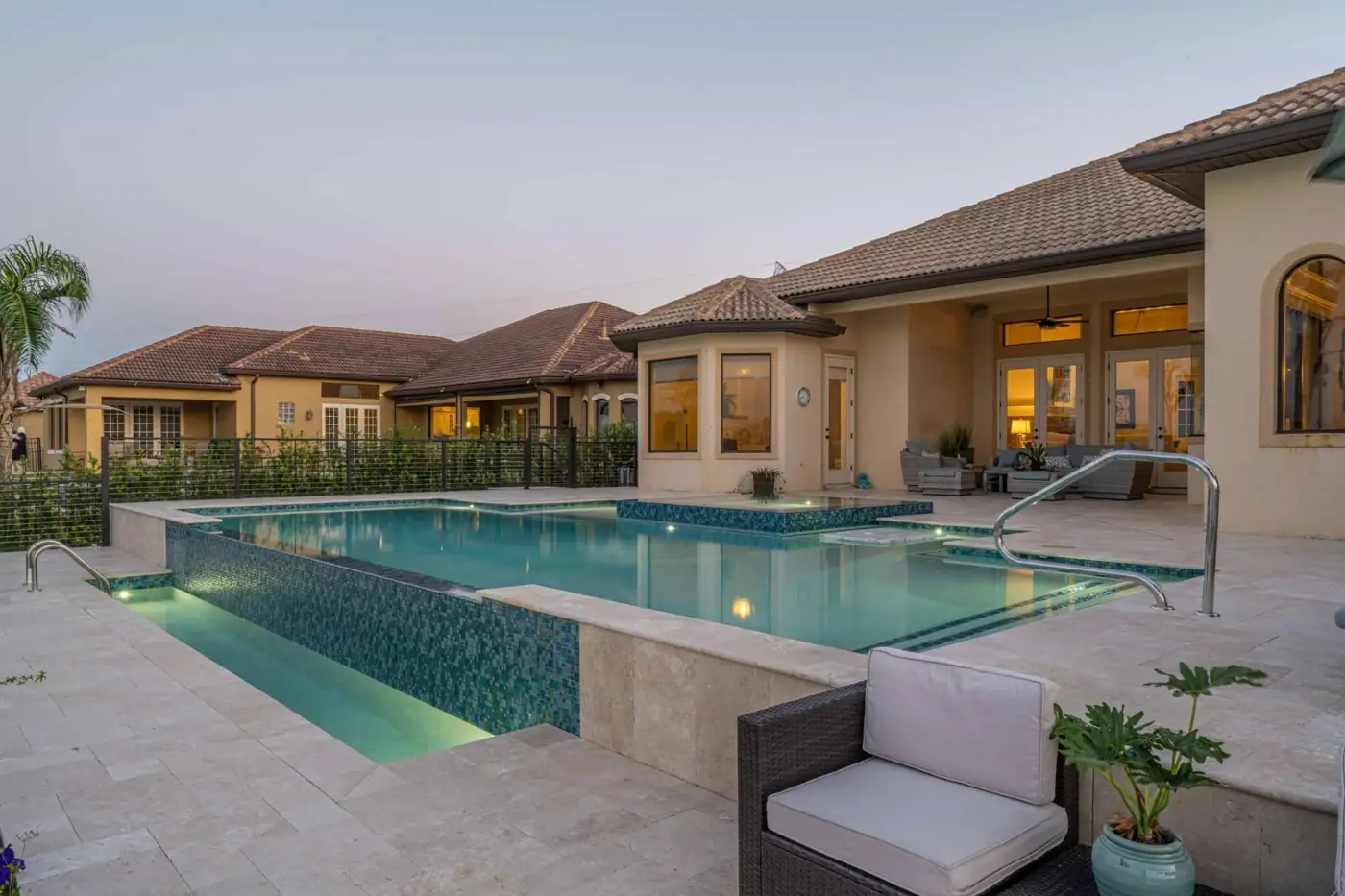
The photo is from our portfolio, not a St. Augustine project. It shows the kind of Mediterranean palette that suits the city: warm stone, a raised spa and a dark, calm water color.
Water color and interior finish
The interior finish sets the color of the water, and warm settings usually look best with deeper, greener or grayer water than the classic bright aqua. Aggregate finishes do it and last: quartz for durability and consistent color, pebble and multi-size aggregate for natural variation, and glass-bead blends for depth. On the coast, a good aggregate finish also resists staining better than plain plaster. We bring finish boards to the design so you can see them wet, in your own light.
Stone and deck
- Shell-stone and travertine tones. Tumbled or honed travertine in cream, walnut or silver picks up coquina's warmth, stays cooler underfoot and handles sand.
- Textured, not polished. Honed and sandblasted surfaces read as old and give better grip on a wet deck.
- Coping that matches the walls. A stone coping in the same family as the deck, or a stucco-finished raised wall with a stone cap, ties the pool to the house.
- Seal it. Natural stone near the ocean lasts longer sealed, on the schedule your installer gives you.
Tile
The waterline tile is where you can add the city's color: hand-painted or encaustic-look patterns that echo Spanish tile, or a glass tile in a muted green or gray that disappears into the water. Glass is non-porous and keeps its color in the sun. Keep the pattern at the waterline and on a spa or fountain, and let the stone do the rest.
Water features with history
A courtyard fountain, a wall spout or a raised spa that spills into the pool belongs in a city full of Spanish courtyards far more naturally than a rock grotto. On tight in-town and historic lots, a small, deep plunge pool with a wall feature can be the right answer. Building in a historic district.
What salt air asks of the rest
- 316 stainless for anything metal: kitchen doors and grills, rails, hardware. It costs more than 304 and lasts far longer near the ocean.
- Equipment on the lee side of the house, behind a screen wall, and above the flood elevation on low lots.
- One equipment family. We install Jandy pumps, filters, heaters, salt systems, automation and lights on every pool, so one manufacturer stands behind the system.
- Fresh-water rinses for stainless, screens and covers every few weeks.